Free Operator's Field Guide · 4 pages
Where AI actually replaces headcount inside a revenue team.
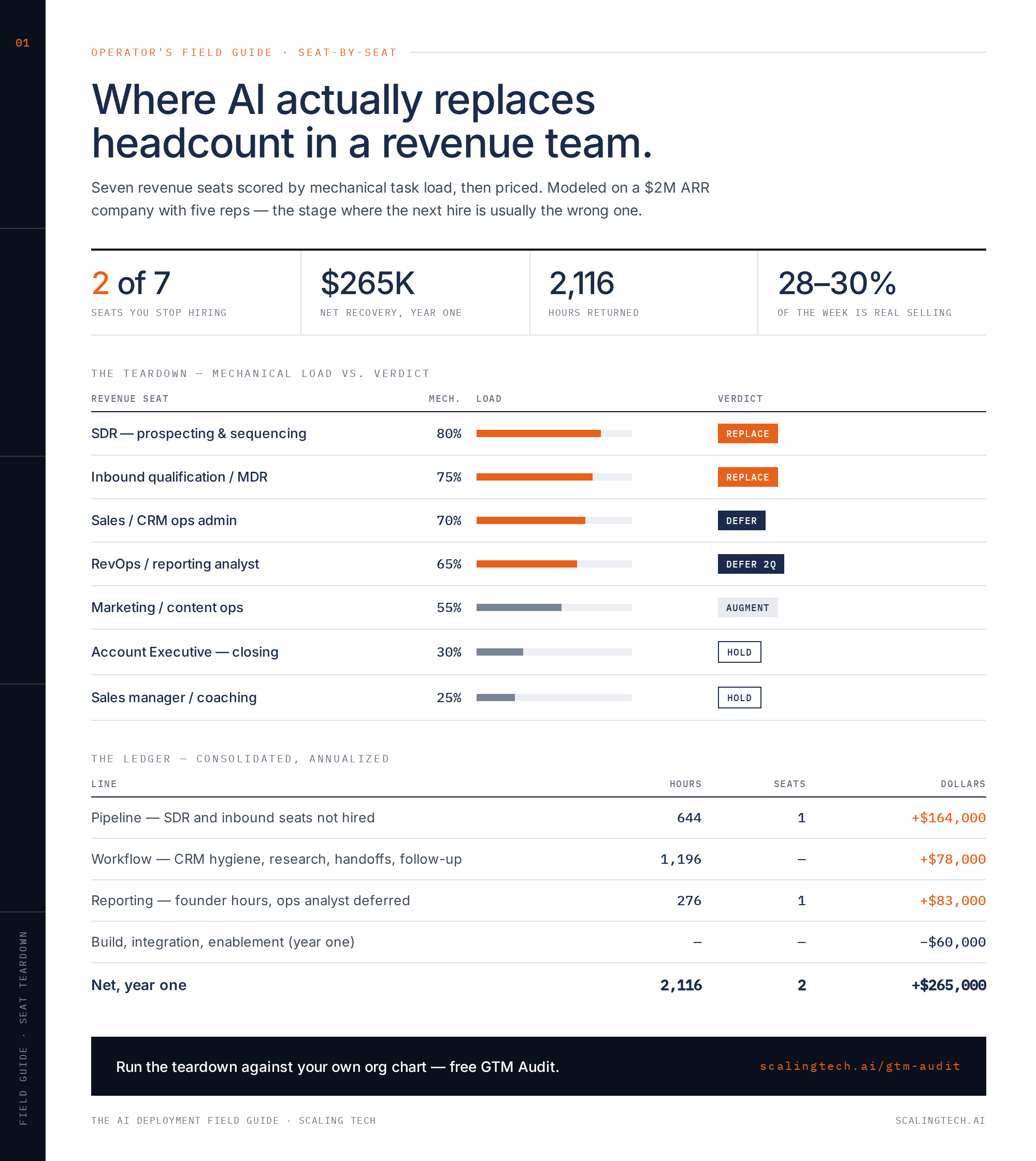
A step-by-step teardown of seven revenue seats, each scored by mechanical task load and given a verdict: Replace, Defer, Augment, or Hold. Then priced — hours, seats, and dollars on one ledger, with the build cost carried honestly.
2 of 7
Seats you stop hiring
$265K
Net recovery, year one
2,116
Hours returned
28–30%
Of the week is real selling
Share or download
Step 01 · The teardown
Seven seats, scored by how mechanical the work is
The question is never "can AI do this job." It is what percentage of the job is retrieval, entry, routing, and formatting. Above roughly 70%, the next hire is the wrong hire.
SDR — prospecting & sequencing
Mechanical load ~80%
List building, enrichment, research, and first-touch sequencing run as workflows. Rep one stays. Rep two never gets hired.
Inbound qualification / MDR
Mechanical load ~75%
Instant enrich, score, route, book. Speed-to-lead drops from hours to seconds — worth more than the seat you were about to fill.
Sales / CRM ops admin
Mechanical load ~70%
Auto-logging, call notes to CRM, dedupe, and stage hygiene remove the reason the role exists. Someone owns the data model — not a new FTE.
RevOps / reporting analyst
Mechanical load ~65%
Snapshots, forecast rollups, and a written weekly digest cover the load. Hire later for modeling, not for assembling decks.
Marketing / content ops
Mechanical load ~55%
Drafting, repurposing, and campaign QA compress hard. Positioning does not. Same headcount, roughly double the output.
Account Executive — closing
Mechanical load ~30%
Prep, recaps, and CRM work come off the plate — about 8 hours a week back. Multi-stakeholder trust is not a retrieval problem.
Sales manager / coaching
Mechanical load ~25%
Call review and scorecarding get faster and more honest. Accountability and pipeline judgment stay with the person who owns the number.
Want the same scoring run against your org chart — run the 5-minute GTM Audit and get a personalized read on which seat to automate before you hire it.
Step 02 · Price the deployment
Two seats you stop hiring, and 2,116 hours you stop paying for twice
Modeled on a $2M ARR company with five reps. Loaded seller time valued at $65/hr across 46 working weeks, with build, integration, and enablement carried on the same ledger.
| Consolidated, annualized | Hours | Seats | Dollars |
|---|---|---|---|
| Pipeline — SDR and inbound qualification seats not hired | 644 | 1 | +$164,000 |
| Workflow — CRM hygiene, research, handoffs, follow-up drafting | 1,196 | — | +$78,000 |
| Reporting — 276 founder hours, ops analyst deferred two quarters | 276 | 1 | +$83,000 |
| Build, integration, and enablement (year one) | — | — | −$60,000 |
| Net, year one | 2,116 | 2 | +$265,000 |
The limits
Four places AI does not replace headcount
Multi-stakeholder trust
A six-person buying committee resolves risk through relationship, not retrieval. No agent carries that.
Pipeline judgment
Calling a deal dead, re-sequencing a quarter, deciding what not to chase — accountability sits with a person.
Positioning decisions
AI produces more of the message you already have. It does not decide which message is true.
Broken data models
Automation on top of dirty CRM data scales the error. Infrastructure precedes agents, always.
Step 03 · Deploy
The 90-day deployment sequence
Day 30
Data layer
CRM hygiene, enrichment, routing rules, and a data model the agents can trust. Nothing automated runs before this.
Day 60
Pipeline seats
AI SDR workflows and inbound qualification: enrich, score, route, book. The two Replace verdicts go live first.
Day 90
Workflow & reporting
Auto-logging, recaps, weekly digest, and instrumentation. Measured in selling hours per rep, not tools deployed.
Frequently asked
Questions operators ask before deploying
Where does AI actually replace headcount on a revenue team?
In two seats reliably: outbound SDR prospecting and sequencing (about 80% mechanical task load) and inbound qualification / MDR (about 75%). Both are retrieval, enrichment, scoring, and routing problems. Sales ops admin and RevOps reporting are deferrals rather than replacements — the work compresses enough that the hire moves out two quarters. Account Executives and sales managers hold.
How much does deploying AI across a revenue team actually return?
On a modeled $2M ARR company with five reps: $265,000 net in year one, 2,116 hours returned, and two seats deferred — after carrying $60,000 of build, integration, and enablement cost honestly on the same ledger. The largest single line is the second SDR that never gets hired ($164,000 net).
Should I fire my SDR and replace them with AI?
No. The verdict is about the next hire, not the current one. Rep one stays for live conversations, objection handling, and multi-thread follow-up. Rep two never gets hired because list building, enrichment, research, and first-touch sequencing run as workflows instead of as a person's calendar.
Where does AI fail to replace headcount?
Four limits: multi-stakeholder trust in a closing cycle, pipeline judgment and accountability, positioning and narrative decisions, and any workflow sitting on a broken data model. Automating a broken process only produces failure faster — infrastructure precedes agents.
What is the deployment sequence?
Ninety days: 30 days on the data layer (CRM hygiene, enrichment, routing rules), 30 days on the pipeline seats (AI SDR workflows and inbound qualification), 30 days on workflow and reporting automation with instrumentation. Success is measured in selling hours per rep, not in tools deployed.
Free GTM Audit
Run the teardown against your own org chart
Answer a short set of questions. Get a specific read on which revenue seat to automate before you hire it.
Start my free auditBuilding the pipeline layer first? Read the AI SDR automation guide →