
Jump to Section
What is the best GTM framework for B2B SaaS?
The Throttled Growth Framework constrains scaling velocity until unit economics are proven, then deploys AI-driven systems across four pillars—Market, Product, Channel, and Model. It sequences ICP refinement, CAC/LTV optimization, messaging rebuilds, and automation to prevent the #1 startup killer: scaling broken funnels. Companies achieve 60% cost reduction and 5X output within 90 days.
1. The Problem with 'Growth'
Most B2B companies don't have a growth problem — they have a foundation problem. Resources flow into GTM motions built on untested ICP definitions, messaging that fails to resonate with actual buyers, and automation layered on top of broken unit economics. The result is predictable: CAC spirals, conversion flatlines, and the board loses confidence.
The pattern repeats across verticals: early traction through founder-led hustle gives way to premature scaling — hiring SDRs, blasting outbound volume, and adding tools — without validating the underlying economics. Consequently, the revenue engine consumes more fuel than it generates, whereas a constrained, data-validated approach would compound returns at every stage.
The Scaling Graveyard — Common Patterns:
- • Automating outbound before validating conversion
- • Hiring SDRs before the founder has a repeatable close pattern
- • 10x-ing volume before fixing messaging that converts at 1%
- • Investing in tooling before defining ICP with surgical precision
- • Chasing ARR milestones while ignoring CAC payback periods
2. The 4-Pillar GTM Framework
The framework operates on a single principle: constrain before you accelerate. Prove each layer works before adding the next. It's structured across four interconnected pillars.
Market
ICP definition, TAM analysis, competitive positioning, and buyer persona mapping against closed-won data.
Product
Value prop alignment, PLG vs. Sales-Led model selection, and pricing architecture tied to unit economics.
Channel
Outbound, inbound, partner, and PLG motion design. Channel-specific CAC benchmarking and sequencing.
Model
Revenue model design, CAC/LTV optimization, payback period targeting, and unit economics validation.
"The fastest way to burn cash isn't overspending on ads—it's scaling a sales motion that doesn't convert."
3. Phase 1: Diagnose — Finding the Fractures
The Diagnose phase operates as a forensic audit across the entire GTM stack — examining targeting precision, messaging resonance, channel efficiency, and conversion mechanics. The objective is to surface what the data reveals about fracture points, rather than relying on assumptions or internal narratives about where the system breaks down.
The Diagnostic Checklist:
- Win/loss analysis across last 50 deals
- ICP validation against actual closed-won customers
- Message-market fit testing with A/B outbound sequences
- Pipeline stage conversion rates and time-in-stage metrics
- CAC payback period calculation by channel and segment
- Full-loaded CAC: salaries, tools, marketing, and overhead
"Scaling Tech Partners didn't just tune up our messaging... he tore it down and rebuilt it from the studs up. In 90 days, he rebuilt our entire brand narrative, refined our ICP, rebuilt our GTM strategy, and stood up a fully automated outbound SDR engine that actually works."
Robert
Sobo.ai
4. Phase 2: Design — Rebuilding from the Studs Up
Surface-level optimizations — tweaking subject lines, adjusting cadences — produce marginal gains. The Throttled Growth approach deconstructs the GTM foundation and rebuilds from validated first principles.
ICP Reconstruction
A functional ICP is not "mid-market SaaS companies." It is the specific intersection of company signals, buyer personas, and timing indicators that predict a high-probability close. Reconstruction uses closed-won data to isolate the 20% of accounts generating 80% of revenue, then maps the firmographic, technographic, and intent patterns that distinguish those accounts from the rest of the pipeline.
Messaging Overhaul
The methodology goes beyond copy optimization. It involves rebuilding the entire brand narrative — positioning, value propositions, outbound sequences, and sales decks — to map directly to the pain points surfaced by closed-won analysis. The architecture ensures messaging resonates with the specific buying triggers identified during the Diagnose phase.
PLG vs. Sales-Led Decision
The model choice impacts everything downstream. Product-Led Growth works when your product delivers value before a human touches the deal. Sales-Led works when deal complexity requires consultative selling. Most companies at $1M-$10M ARR need a hybrid: PLG for acquisition, Sales-Led for expansion.
5. Phase 3: Deploy — AI-Powered Acceleration
Deployment only begins after unit economics are validated, messaging is proven, and the ICP is surgically defined. At this stage, automation functions as a force multiplier — scaling a system that already converts, rather than amplifying a system that burns capital.
What Gets Automated:
- • Lead Research: AI scans 50+ data sources for ICP-matched prospects
- • Outbound Sequences: Hyper-personalized multi-channel campaigns at scale
- • Intent Detection: Real-time monitoring of buying signals and trigger events
- • Pipeline Ops: Automated stage progression, forecasting, and alert systems
- • Reporting: Real-time dashboards tracking CAC, LTV, and conversion by segment
A well-configured AI outbound stack enables one Account Executive to generate the pipeline output of three SDRs. For a deep dive, see our guide on The AI Outbound Playbook.
"Working with Daniel for our GTM strategy was a gamechanger. His 20+ years of experience helped us build a scalable sales framework that immediately improved our efficiency. If you need Fractional GTM Execution, I highly recommend Scaling Tech."
Rob
Core12Tech
6. CAC/LTV Optimization: The North Star
The CAC/LTV ratio remains the definitive indicator of GTM health — it reveals whether the revenue engine creates value or destroys it. The benchmark is 1:3: for every dollar of acquisition cost, the system must generate three dollars in lifetime value, with a target payback period of 12-18 months for capital efficiency.
- Full-loaded CAC: Include sales salaries, tools, marketing spend, and overhead allocation
- Cohort-based LTV: Calculate actual retention curves, not projected best-case scenarios
- Payback period: Target 12-18 months CAC payback for capital efficiency
- Segment by channel: Inbound, outbound, and partner channels often have 3-5x CAC variance
The AI Efficiency Multiplier
Companies using AI-automated outbound (Clay + GPT-4o) report 60-80% reductions in cost-per-qualified-lead while maintaining or improving lead quality. This alone can shift a 1:2.5 ratio to 1:5+.
7. Growth Maturity Matrix: Seed vs. Series A/B
GTM architecture must align to stage maturity. A Seed-stage motion — founder networks, manual outbound, spreadsheet pipelines — structurally cannot support Series A velocity. The matrix below maps the operational requirements at each inflection point.
| Dimension | Seed Stage GTM | Series A/B GTM |
|---|---|---|
| Sales Motion | Founder-led, relationship-driven | Systematized playbooks, AI-augmented AEs |
| ICP Definition | Broad hypothesis, iterating | Data-validated, firmographic + intent signals |
| CAC/LTV | Acceptable at 1:2, proving market | Must be 1:3+, targeting 1:5 with AI |
| Tech Stack | Lean: CRM + basic email | Orchestrated: Clay + Instantly + CRM + AI |
| Outbound | Manual, founder networks | AI-personalized, multichannel at scale |
| Pipeline Visibility | Spreadsheets, gut feel | Real-time dashboards, automated forecasting |
| Revenue Model | Proving willingness to pay | Expansion revenue, NDR > 110% |
The GTM Feedback Loop
Continuous loop — each cycle sharpens targeting and reduces CAC
See how you rank
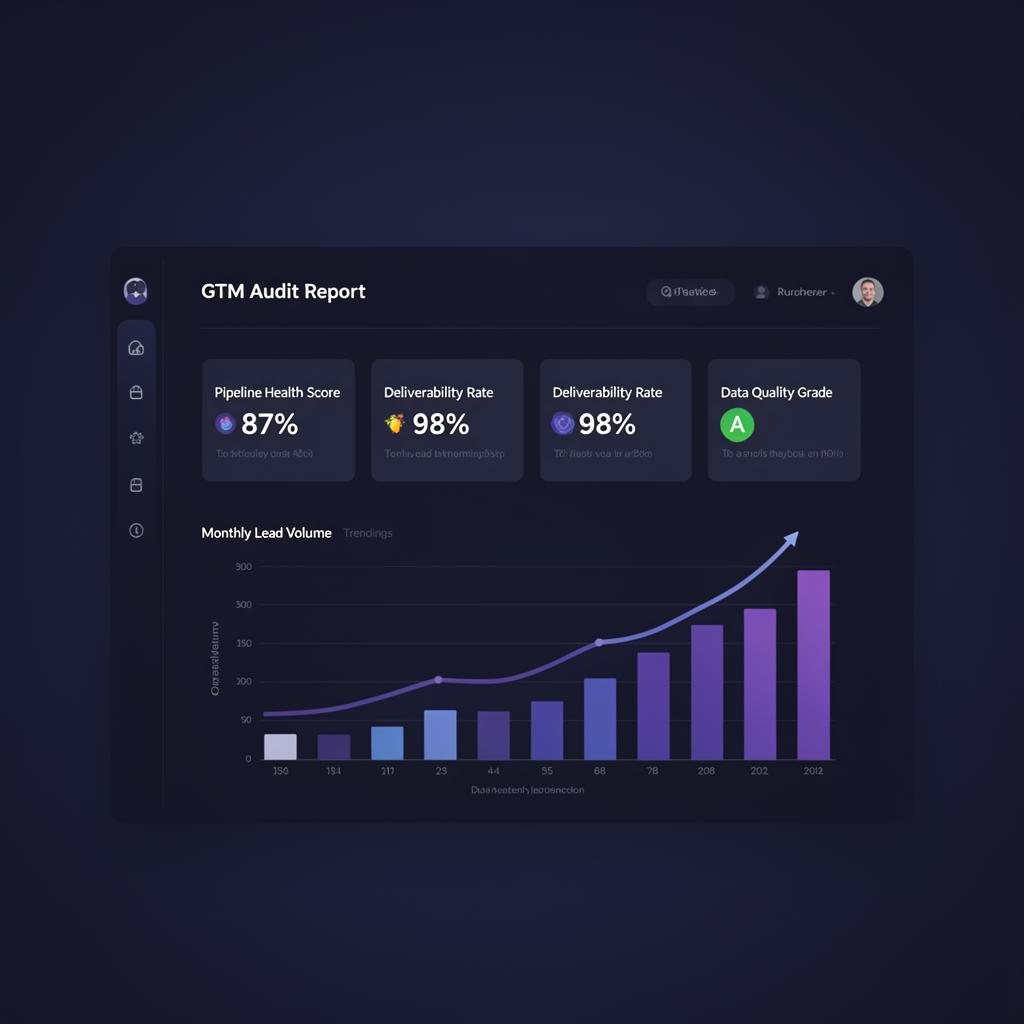
Get a personalized GTM Audit Report built for the AI era.
8. The 2026 GTM Readiness Audit
Every SaaS company has a GTM stack. Few have a GTM system. The difference is the space between tools—the handoff points where leads fall through cracks, data decays, and revenue evaporates. Use this checklist to audit your readiness across three categories.
The "Frankenstein Stack" Problem
The typical mid-market SaaS company has 12-18 sales and marketing tools adopted independently. The result: enrichment data never reaches sequences, CRM records update manually, deliverability degrades silently, and AI personalization sits in a silo. Most companies are bleeding 20-40% of pipeline value through these invisible handoff gaps.
Data Enrichment & Quality
- Enrichment coverage rate at 85%+ on first pass (waterfall providers)
- SDRs spend less than 5 minutes per lead on research
- Multi-source verification: email, phone, LinkedIn confirmed
- Intent signals automated: job postings, funding, tech stack changes
- Data decay rate monitored and refreshed quarterly
Operations & CRM Hygiene
- CRM field completion at 95%+ on active deals
- Pipeline reports generate in under 60 seconds
- Stage definitions documented with clear entry/exit criteria
- Automated stage progression and forecasting alerts
- Zero manual handoffs between enrichment → outreach → CRM
Sales & Deliverability
- Cold email inbox placement at 90%+ (SPF, DKIM, DMARC verified)
- Reply rates at 8-15% on cold outbound
- AI personalization referencing prospect-specific context
- Domain reputation and warm-up cadences monitored
- Multichannel sequencing: email, LinkedIn, phone coordinated
60%
Cost Reduction
Operational costs slashed through intelligent automation of manual GTM workflows
5X
Output Increase
Pipeline generation multiplied through AI-powered outbound and enrichment systems
The Bottom Line
Scaling isn't about doing more. It's about doing the right things in the right order. The Throttled Growth Framework gives you that order: Diagnose what's broken, Design the surgical fix, Deploy AI to accelerate what's proven.
- • Start with unit economics: Get CAC/LTV to 1:3 or better before scaling
- • Systematize founder sales: Remove the founder from the process while maintaining close rates
- • Deploy AI on proven foundations: Multiply team capacity without multiplying headcount
- • Audit quarterly: Keep your GTM stack calibrated as tools and markets shift
The companies that win don't scale fastest—they scale smartest. And that starts with the discipline to constrain before you accelerate.
Amplify. Automate. Accelerate.
We'll audit your current data sources, design a custom waterfall workflow in Clay, configure AI personalization, and have verified leads flowing into your CRM within 10 days — all managed by our fractional execution team.
Frequently Asked Questions
Common questions about this topic
Read the foundational pillars
The deeper reference guides this article builds on.
GTM Automation Tools 2026
The 4-pillar stack we deploy for B2B SaaS scaling to $10M ARR.
Read the pillarHubSpot vs Salesforce
CRM choice by funding stage and the migration tax if you pick wrong.
Read the pillarFractional RevOps vs. Full-Time
Advisory partner, fractional operator, or $300K CRO — when each fits.
Read the pillarRelated Insights
The AI SDR Master Guide
Master AI-powered sales development with autonomous agents for lead research and outreach.
The Waterfall Enrichment Blueprint
Generate 500+ verified leads weekly with multi-source data enrichment.
Reducing SDR Headcount: The $1M AI Architecture
The technical architecture to replace traditional SDR teams with AI-native systems.
The Founder-Led Sales Trap
The 3-step framework to escape founder-led sales and build scalable GTM systems.