
Jump to Section
The Series A Foundation: The Lean Stack
Series A occupies a structural gap: too large for founder-led operations across every function, yet too small to justify enterprise-grade tooling. The lean stack architecture prioritizes speed, simplicity, and cost efficiency for teams under 10 salespeople — delivering 80% of enterprise capability at 10% of the cost. For founders still running deals personally, our founder-led sales transition playbook covers the hiring sequence and handoff timing that pair with this stack.
The $500-$2K/Month Lean Stack:
- HubSpot Sales Hub Starter — CRM, pipeline management, basic automation ($50/user/month)
- Apollo.io — 265M+ contacts, email verification, ICP list building ($99-$399/mo)
- Instantly.ai — Cold email infrastructure with unlimited warmup ($97-$492/mo)
- Zapier — Glue between tools for custom workflows ($100-$300/mo)
- GPT-4o — Basic email personalization and opening lines ($50-$100/mo)
Series A Decision Framework — Choose Lean If:
- • Sales team under 10 people
- • Straightforward deal structure (single product, simple pricing)
- • Sales cycle under 60 days
- • No regulatory/compliance data requirements
- • Limited internal technical resources for stack administration
Daniel's Note: The best stack is the one your team actually uses consistently. Data hygiene matters more than tool sophistication at Series A. When in doubt, start lean — it's easier to migrate up than to undo enterprise complexity.
The $10M ARR Scale-Up: The 4-Pillar Engine
Between $2M and $10M ARR, the lean stack encounters structural limitations — governance requirements emerge, multi-touch attribution becomes critical, and automation complexity exceeds what basic integrations can handle. The 4-Pillar Revenue Engine consolidates 10+ disconnected tools into a single managed loop, eliminating the data fragmentation that caps growth at this stage.
The "Tool Rich, Data Poor" Problem
Here's the pattern in every company between $1M and $5M ARR: the founder has bought 10-15 SaaS tools, each solving one narrow problem. Prospecting Apollo. Enrichment Clearbit. A spreadsheet to glue it together.
Result: $5K-$15K/month in subscriptions, but pipeline decisions still based on gut feeling. Data dies in transit. Leads fall through cracks. Someone — usually a $75K/year ops hire — spends 80% of their time playing "human API."
Enrichment — Clay
Waterfall data enrichment from 50+ sources with automatic verification
Outreach — Instantly / Smartlead
Multi-channel outbound at scale with enterprise-grade deliverability
Intelligence — GPT-4o / Claude
AI-powered personalization and ICP scoring on every prospect
CRM Sync — HubSpot / Salesforce
Single source of truth with automated pipeline tracking
Before: The Typical $3M-$5M Stack (10+ Tools)
After: The Scaling Tech 4-Pillar Engine
| Metric | Before Audit | After Consolidation |
|---|---|---|
| Monthly Tool Spend | $8K-$15K | $2K-$4K |
| Manual Data Work (hrs/wk) | 20-30 hours | 2-3 hours |
| Lead-to-CRM Latency | 24-48 hours | Real-time |
| Data Accuracy | 60-70% | 95%+ |
| Tools Requiring Maintenance | 10-15 | 4 |
| Pipeline Output | Baseline | 3-5x increase |
The 2026 Tool Directory: By Category
Best for Data Enrichment
Clay
$149–$800/mo- • Waterfall enrichment from 50+ data providers
- • AI-powered workflows and seamless CRM sync
- • Role: Lead research, enrichment, signal detection
Apollo.io
$99–$399/mo- • 265M+ contacts with email verification and intent data
- • Best value for startups before graduating to ZoomInfo
- • Role: ICP list building, contact sourcing, intent signals
Daniel's Note: For the full enrichment methodology, see the Waterfall Enrichment Blueprint.
Best for Outreach & Deliverability
Instantly.ai
$97–$492/mo- • Unlimited email accounts with built-in warmup
- • Smart rotation and deliverability monitoring
- • The standard for cold email infrastructure
Smartlead
$79–$174/mo- • Multi-channel: email + LinkedIn + call sequences
- • Ideal for multi-touch ABM campaigns
Best for AI Intelligence & Personalization
OpenAI GPT-4o / Anthropic Claude
$50–$300/mo- • Hyper-personalized opening lines at scale
- • Pain hypothesis matched to role + company stage
- • 3-5x higher reply rates with human tone
Daniel's Note: See our AI Outbound Playbook for the full personalization workflow.
Best for CRM & Revenue Intelligence
- • HubSpot — Best for Series A through $5M ARR. Fast to implement, affordable, minimal training.
- • Salesforce — Enterprise-grade. Needed at $5M+ with complex deal structures or SOC2/HIPAA.
- • Gong / Chorus — Conversation intelligence ($100-$150/user/mo). Add at $5M+ ARR.
- • Clari / BoostUp — Revenue forecasting ($1-$3K/mo). Add at $5M+ ARR.
Daniel's Note: The HubSpot vs. Salesforce CRM comparison covers which platform fits your stage.
Data Flow Architecture: The Automated Engine
When the four pillars operate as a single closed loop, the "human API" problem — manual data transfers, CSV exports, copy-paste operations — is architecturally eliminated. The sequence below describes the exact data flow:
The Automated Outbound Loop
- Define ICP in CRM: Set criteria for target accounts
- Build list in Apollo: Export contacts matching ICP
- Enrich in Clay: Add LinkedIn, company signals, intent data
- Generate personalization: GPT-4o creates unique opening lines from context
- Launch in Instantly: Multi-step sequences with smart rotation
- Sync to CRM: All activity logged, replies trigger notifications
- Book meetings: Calendly/Chili Piper handles scheduling
CRM Integration Points:
- • Bi-directional sync with Clay (contact enrichment → CRM)
- • Activity logging from Instantly (email sends, opens, replies)
- • Meeting booking attribution (Calendly/Chili Piper → CRM)
- • Pipeline analytics and forecasting dashboards
Killing Tool Bloat: The 5-Step Audit
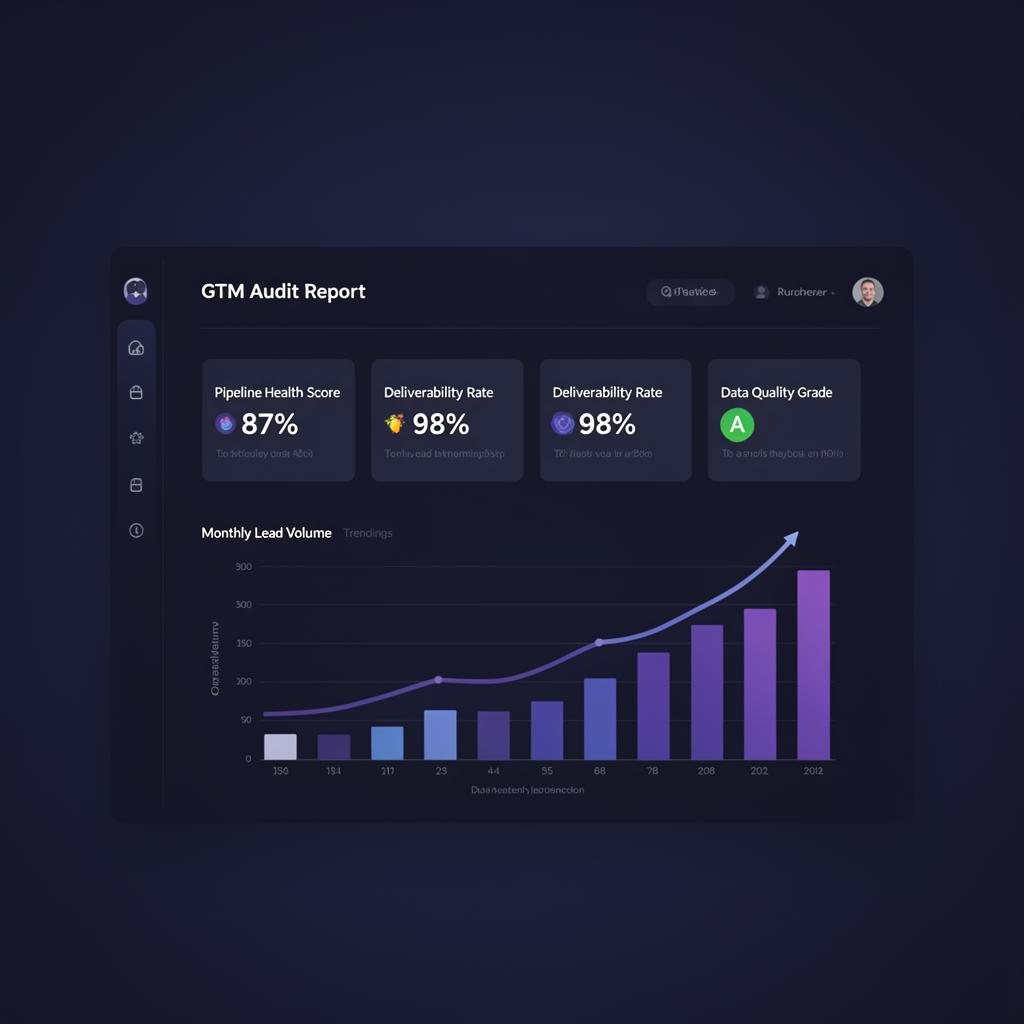
Here's the exact process we use with every client engagement. It takes 2-3 weeks and typically reveals 40-60% in wasted spend.
Step 1: Inventory & Map Current Tools
Document every tool in your revenue stack and map data flows between them. We typically find 3-5 tools the team didn't even know they were still paying for.
Step 2: Identify Redundancy & Data Gaps
Flag tools with overlapping functionality and spots where data dies between systems. The usual culprits: manual CSV exports, broken Zapier chains, and 'swivel chair' processes.
Step 3: Score Each Tool on True ROI
Calculate cost-per-output for each tool. A $500/mo tool that requires 10 hours of manual work has a true cost of $1,200+/mo. Most companies discover half their stack has negative ROI when you factor in labor.
Step 4: Design the 4-Pillar Architecture
Map your consolidated stack across the four pillars: Enrichment (Clay), Outreach (Instantly/Smartlead), Intelligence (GPT-4o/Claude), and CRM Sync (HubSpot/Salesforce).
Step 5: Deploy & Monitor
Implement the consolidated stack with automated data flows, then monitor weekly pipeline velocity and CAC metrics. Most clients see measurable improvement within the first 30 days.
Daniel's Note: Step 3 is where most companies get surprised. That $200/mo "nice-to-have" tool usually costs $800+ when you factor in the ops time to maintain it.
Why a GTM Operating System Beats a Point-Tool Stack
Most teams buy Clay, Smartlead, and an AI layer and call it a stack. That's three contracts and zero owners. The work that turns those tools into pipeline — domain warmup, deliverability monitoring, list hygiene, CRM sync, board-ready reporting — falls on whoever picks up the Slack thread first. An operating system runs the same four pillars as one managed loop with a single owner on the hook for output.
| Dimension | Point-Tool Stack | GTM Operating System |
|---|---|---|
| Time to first sequence | 6–12 weeks | 2–4 weeks |
| Owner when it breaks | Split across SDR lead, RevOps, vendor support | One fractional architect, accountable end to end |
| Deliverability monitoring | Reactive — caught after reply rates collapse | Continuous — domains and inboxes monitored daily |
| CRM sync hygiene | Manual cleanup every quarter | Automated dedupe + enrichment on write |
| Board-ready reporting | Built ad-hoc in Sheets the week of the board meeting | Pipeline velocity + CAC dashboards live in CRM |
The tools in both columns can be identical. The difference is whether someone owns the loop or just owns the logins. Teams that treat the stack as an operating system recover from breakage in hours; teams that treat it as a tool list lose entire quarters to deliverability cliffs and silent data drift.
Daniel's Note: The fastest way to tell which side a company is on: ask the founder who fixes a deliverability drop at 9pm on a Tuesday. If the answer is "we open a ticket with Smartlead," it's a point-tool stack.
SaaP Engine vs. Traditional Hiring
| Dimension | Scaling Tech SaaP | 3 SDR Hires |
|---|---|---|
| Monthly Cost | $3K–$6K | $15K–$25K |
| Ramp Time | 2–4 weeks | 3–6 months |
| Outbound Capacity | 10K–50K personalized/mo | 3K–6K manual/mo |
| Turnover Risk | Zero | ~35% annual |
| Annual ROI | 5–10x return | Break-even 12–18 mo |
Scalable Systems, Comparison, Intent, Partners, and Scraping
Five sibling decisions every $1M–$10M ARR RevOps lead has to make once the 4-pillar stack is live. Each is a single architectural choice — get it right and the system compounds.
Scalable GTM Automation Systems
Scalable GTM automation systems are integrated stacks — not point tools — that grow linearly with revenue without re-architecting. The $1M–$10M ARR B2B SaaS pattern: Clay for waterfall enrichment, Instantly or Smartlead for multi-domain outbound, GPT-4o for personalization at zero marginal cost, and HubSpot as the single source of truth. The system scales because every layer hands clean data to the next, and one fractional architect owns end-to-end pipeline health instead of three vendor support queues. Start with our SaaS GTM Checklist to audit your current architecture against the pattern.
GTM Automation Tools: B2B Comparison
The honest B2B comparison for GTM automation tools in 2026: Clay wins enrichment (50+ sources, waterfall logic, $349/mo entry), Instantly wins multi-domain outbound at scale (unlimited sending accounts, $97/mo), Smartlead wins deliverability tuning (per-inbox warmup, $39/mo entry), Apollo wins integrated sequencer-plus-database, and HubSpot wins CRM-as-system-of-record. The mistake every $1M–$10M ARR team makes is buying two tools that overlap 70% — Apollo + Clay, or Outreach + Instantly — instead of picking the dominant tool per pillar and consolidating the rest.
GTM Automation Software with Intent Data
The 2026 stack uses intent data as a routing layer, not a list-buy. Clay pulls intent signals from G2, 6sense, Bombora, and LinkedIn engagement, then scores each account inside the enrichment waterfall before it reaches the outbound queue. GPT-4o reads the intent context and writes the first-line variation; Instantly or Smartlead delivers it. The result: outbound is sent only to accounts showing buying signals in the last 14 days — bounce rates stay under 2% and reply rates triple versus cold list-spray.
B2B GTM Automation Partner: When to Bring One In
A B2B GTM automation partner is worth bringing in once your stack hits three tools that need integrating (Clay + Instantly + HubSpot is the trigger), or once outbound reply rates drop below 1% and nobody on the team can isolate whether it's deliverability, targeting, or copy. The right partner owns the architecture end-to-end — not just configuration — so the system survives the next vendor change or pricing reset. For most $1M–$10M ARR teams that's a fractional engagement, not a full-time hire: see Fractional RevOps for the model.
Top Lead Scraping Tools for GTM
The top lead scraping tools for GTM in 2026 are Apollo (largest B2B contact database), Clay (waterfall scraping from 50+ sources with verification), and LinkedIn Sales Navigator (highest-fidelity professional data). For most $1M–$10M ARR teams, Clay alone replaces 3–4 standalone scrapers because it stitches results from Apollo, ZoomInfo, and SalesNav into one verified record. Avoid raw scrapers without verification — bounce rates above 5% destroy domain reputation and shut down the entire outbound channel within weeks.
What's the Best Tool for Automating GTM Data?
The best tool for automating GTM data in 2026 is Clay — it runs waterfall enrichment across Apollo, ZoomInfo, LinkedIn, and 50+ sources, verifies every record, and routes the cleaned data to HubSpot or your outbound platform. One tool replaces three vendors and one full-time data engineer.
The Bottom Line
Amplify. Automate. Accelerate.
We'll audit your current data sources, design a custom waterfall workflow in Clay, configure AI personalization, and have verified leads flowing into your CRM within 10 days — all managed by our fractional execution team.
Frequently Asked Questions
Common questions about this topic
Related Insights
The Waterfall Enrichment Blueprint
Layer 5+ data providers into a single Clay workflow for 95%+ email accuracy.
Fractional RevOps vs. Full-Time
The $5M ARR guide to deploying Revenue Infrastructure as a Service.
The Founder-Led Sales Trap
Why staying in every deal kills growth — and how to build the system that replaces you.
Engineered RevOps: AI Infrastructure
Why your CRM needs AI infrastructure, not more fields.