
Jump to Section
1. The Managed Security Layer (SaaP)
HealthTech GTM infrastructure functions as the primary trust signal — hospitals evaluate the entire technology posture of a vendor, not the product in isolation. Consequently, compliance architecture must be positioned as the platform itself, not treated as a checkbox exercise downstream of sales.
What Our Managed Security Layer Includes:
Pre-Vetted AI Stack
Every tool in our GTM engine meets BAA and HIPAA requirements
Encryption at Rest & Transit
AES-256 encryption for all prospect and pipeline data
Stakeholder Mapping
Automated committee identification across hospital orgs
Clinical Messaging
AI generates outcome-focused copy, never referencing PHI
When a hospital's CISO asks "Is your outreach HIPAA compliant?"—our clients answer with architecture documentation, not promises.
2. The HIPAA-Compliant AI Sales Stack
The Compliance-First Outbound Loop ensures that every automated touchpoint passes regulatory validation before reaching a clinical buyer's inbox — embedding HIPAA compliance as foundational architecture rather than an afterthought:
Secure Data Sourcing
Pull prospect data from HIPAA-compliant sources only. No scraping clinical directories or PHI-adjacent databases.
PHI-Stripping Logic
Automated filters remove any Protected Health Information before data enters the AI personalization layer.
Secure Personalization
AI generates clinically relevant messaging focused on ROI and patient outcomes—never referencing individual patient data.
Encrypted CRM Delivery
All prospect interactions are logged in an encrypted CRM with audit trails meeting HIPAA §164.312 standards.
This isn't theoretical compliance—it's the exact stack we deploy for HealthTech clients selling to hospital networks, payers, and clinical research organizations.
3. Hospital Stakeholder Mapping
Hospital purchases involve interconnected committees and approval chains. Understanding who influences decisions—and when—is critical to managing 12–18 month sales cycles. Our GTM Strategy Consulting includes detailed stakeholder analysis.
| Stakeholder Group | Primary Concern | Our Approach |
|---|---|---|
| Clinical Champions | Workflow efficiency, patient outcomes | Outcome-focused AI messaging |
| IT / CISO | Data security, integration risk | Pre-built compliance docs & BAAs |
| C-Suite (CMO, CIO) | Strategic alignment, ROI | Board-ready ROI models |
| Value Analysis Committee | Cost-benefit, standardization | Total cost analysis + impl. plans |
| Procurement | Vendor risk, contract terms | Pre-filled VRA questionnaires |
Our fractional team maps the entire buying committee before the first email is sent—so every touchpoint speaks to the right person's priorities.
4. The Fractional Edge: Clinical Sales Leadership
Healthcare sales isn't just long—it's politically complex. You're selling to CMOs who care about patient outcomes, CFOs who care about cost reduction, and CISOs who will block the deal if your security posture isn't airtight. We don't just "send emails"—we navigate the 12-month hospital sales cycle.
How Our Fractional Team Manages HealthTech Complexity:
- • Multi-Stakeholder Navigation: We map the entire buying committee and tailor messaging for each role
- • Security Review Acceleration: Pre-built compliance documentation reduces review timelines from 12 months to 8 weeks
- • Pipeline Stamina: Our fractional leads maintain pipeline nurture through 6–18 month cycles without full-time VP overhead
- • Clinical Credibility: Every automated touchpoint references patient outcomes, workflow efficiency, and evidence-based ROI
Our fractional team acts as your "Regulatory Buffer"—ensuring every automated message adheres to industry standards while maintaining high conversion rates.
5. Building Clinical Champions
Clinical champions—physicians, nurses, or department heads who advocate for your solution—are the key to accelerating hospital deals. They provide internal credibility that no amount of marketing can replicate.
Amplify. Automate. Accelerate.
- Amplify: Give champions the data, case studies, and presentations they need to advocate internally
- Automate: Create champion enablement portals with self-service resources and ROI calculators
- Accelerate: Connect champions at different institutions to share success stories and build peer validation
The Bottom Line
HealthTech GTM isn't about better marketing—it's about deploying trust infrastructure that hospitals can verify. Our HIPAA-compliant SaaP platform and fractional execution team give you the compliance posture of an enterprise vendor and the agility of a startup. Stop losing deals to security reviews. Start closing them.
Amplify. Automate. Accelerate.
Amplify. Automate. Accelerate.
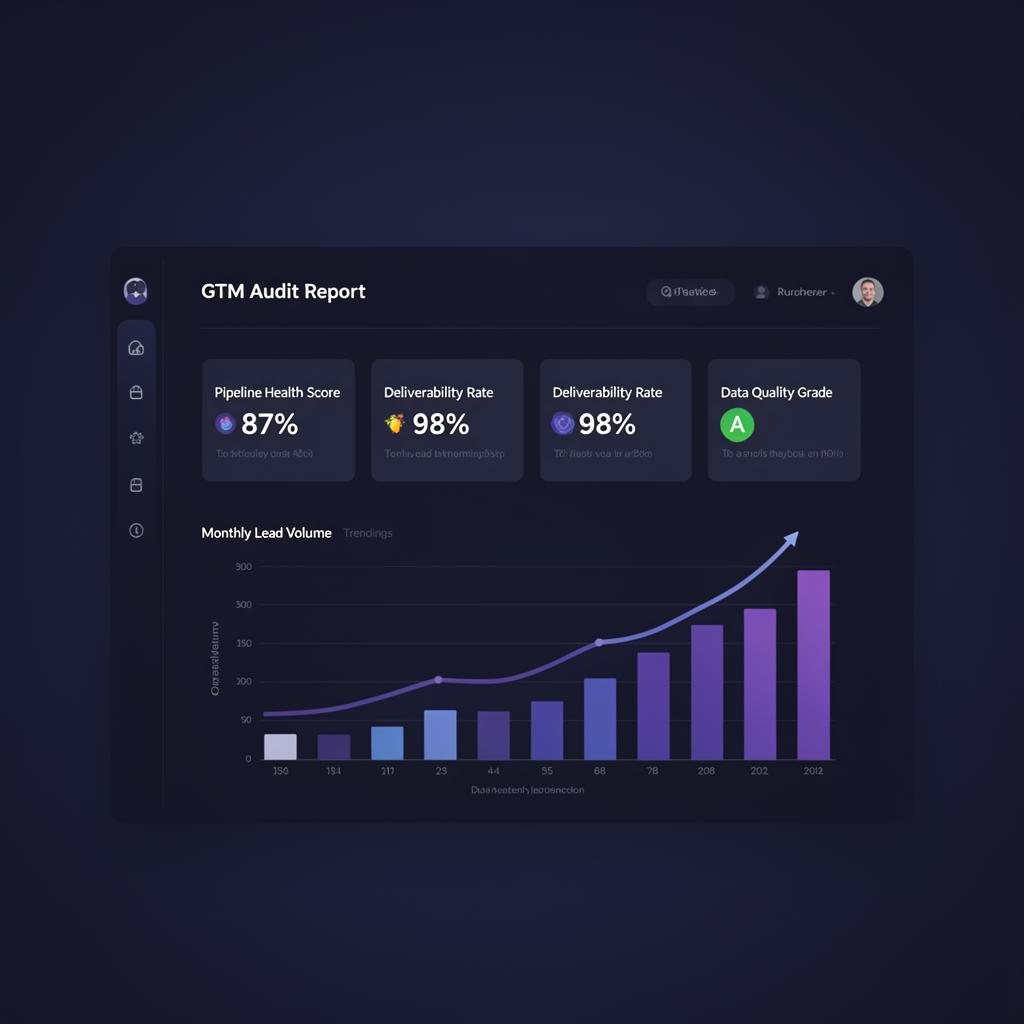
We'll audit your current data sources, design a custom waterfall workflow in Clay, configure AI personalization, and have verified leads flowing into your CRM within 10 days — all managed by our fractional execution team.
Frequently Asked Questions
Common questions about this topic
Read the foundational pillars
The deeper reference guides this article builds on.
GTM Automation Tools 2026
The 4-pillar stack we deploy for B2B SaaS scaling to $10M ARR.
Read the pillarHubSpot vs Salesforce
CRM choice by funding stage and the migration tax if you pick wrong.
Read the pillarFractional RevOps vs. Full-Time
Advisory partner, fractional operator, or $300K CRO — when each fits.
Read the pillar